What Does That Mean? Understanding Early Intervention and Special Education Terms
This glossary explains common words and acronyms you may hear when starting out on your early intervention or special education journey.
504 Plan
A written plan that helps students with disabilities receive support and accommodations at school such as extra time for tests or a quiet workspace. Unlike an IEP, a 504 Plan doesn't provide specialized instruction.
Applied Behavioral Analysis (ABA) Therapy
A type of therapy that helps with skills including behavior, language, and learning. ABA can be delivered in school, home, and community settings.
Behavior Therapist
A licensed professional who helps a child change or modify behaviors using a variety of techniques.
Developmental Disability
A group of conditions that affect a child's growth and development. These conditions impact various areas, including learning and problem-solving, movement, communication, and behavior.
Developmental Specialist
A certified professional specializing in child development, special education, and interventional strategies for children birth to 3 years old enrolled in Early Intervention.
Ohio Early Intervention (EI)
Part of Help My Grow’s system of supports. A program that provides services to children birth to 3 years old with developmental delays and their families.
Preschool Special Education-
A program for children ages 3 to 5 years old with developmental delays. These services are provided through the child’s school district.
Early Intervention Service Coordinator (EISC)
A first contact for families in EI. EISCs help families in a variety of ways, including coordinating eligibility, assessment, and the development of the IFSP. Service Coordinators also assist families with accessing services and support.
Individualized Education Program (IEP)
A written plan for students ages 3-21 years old that outlines a student’s learning goals and services.
Individualized Family Service Plan (IFSP)
A written plan for children birth to three years old and their families. The IFSP outlines supports and services to be provided in the home or community.
Intervention Specialist
A special education teacher that supports learning, social, and behavioral needs.
Itinerant Teacher
An intervention specialist from the school district who supports a child with an IEP in their home or community.
Occupational Therapist (OT)
A licensed professional that helps a child develop fine motor skills such as writing, dressing, and playing. They may also support sensory and feeding concerns.
Physical Therapist (PT)
A licensed professional that helps a child develop gross motor skills such as walking, climbing, and balance. They may also help families obtain equipment such as walkers, wheelchairs, or braces.
Self-Regulation
The ability to manage your feelings, actions, and thoughts.
Sensory Processing
How our body understands and organizes information through our five senses. Sensory processing helps an individual understand their environment and what is going on around them.
Speech and Language Pathologist (SLP)
Commonly referred to as a speech therapist. A licensed professional that helps a child develop their language and communication skills. They may also address feeding and swallowing concerns.
Visual Support
Pictures, symbols, or written words that help a child understand daily tasks and situations. Some examples of visual supports include visual schedules, timers, and communication cards.

Who can I contact if I need help understanding these words?
OCALI’s Family Support Specialists are here to support you on your Special Education journey.
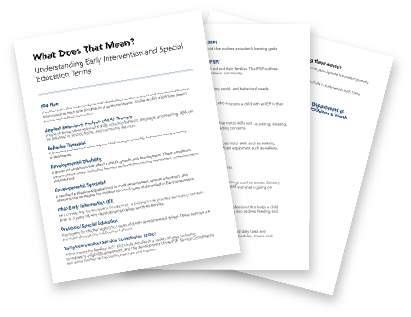
Download This Page as a Document: What Does That Mean? Understanding Early Intervention and Special Education Terms (PDF)
Developed October, 2025 by OCALI’s Center for the Young Child in partnership with Ohio Department of Children and Youth